
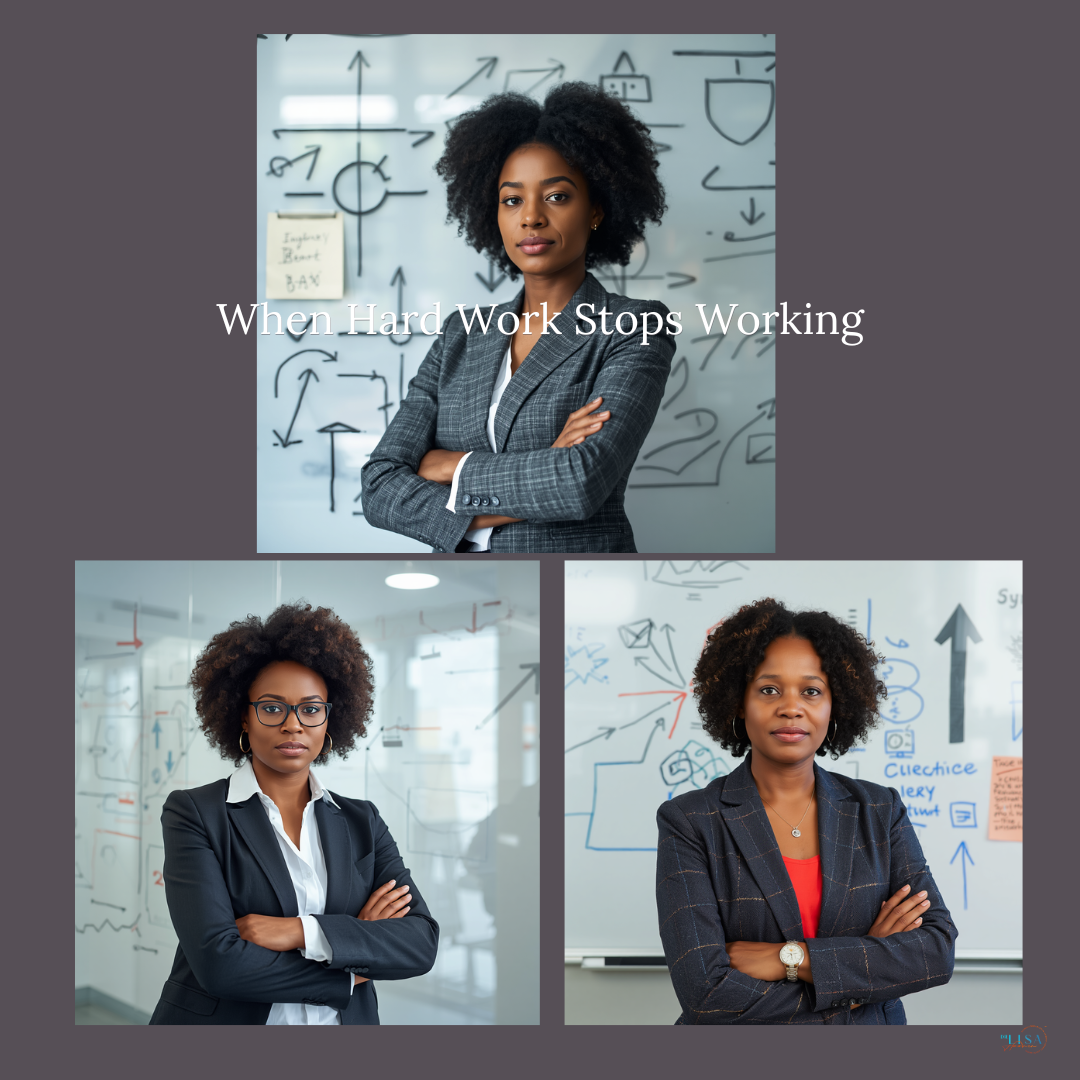

You can build a whole life on hard work and still wake up one day realizing hard work is the thing keeping you stuck.
Not because effort is bad.
Yes, this was me—running three businesses with project deadlines crashing into the same week and wearing the exhaustion like a merit badge.
Effort matters. Discipline matters. Consistency matters. There is no serious life, business, career, book, movement, ministry, company, or calling that does not require work. Anybody selling ease without effort is probably also selling glitter in a rainstorm—pretty, but not useful.
But there comes a point where hard work is no longer the problem or the solution.
There comes a point where the issue is not whether you are capable—you already proved that. The issue is whether the structure around your effort is strong enough to hold the life you are trying to build.
And for a lot of ambitious, multi‑passionate people, that is where things start to get interesting.
Hard work got you here.
But it may not be able to get you there.
The Myth of “Just Work Harder”
Hard work is praised because it is visible.
People can see the late nights. They can see the full calendar. They can see the person who answers quickly, fixes the problem, remembers the details, carries the meeting, rescues the project, and somehow still manages to look composed enough in public to make everybody else think, She must have it together.
But visibility is not the same as sustainability.
A person can be productive and overextended. A person can be reliable and resentful. A person can be gifted and structurally unsupported.
That is the part we do not talk about enough.
We glorify the person who can carry everything, then act surprised when carrying everything becomes too heavy.
We call it commitment.
We call it excellence.
We call it being built different.
Sometimes it is all of those things.
But sometimes it is just a bad system being held together by a very capable person.
Let me say this plainly: your capacity should not be the only thing keeping your life from collapsing.
When Effort Becomes the Bottleneck
Hard work stops working when every result depends on your personal energy.
That is the test.
If everything requires you to remember it, initiate it, explain it, fix it, approve it, track it, or rescue it, then you do not have a system. You have a dependency.
And the dependency is you.
At first, that may feel powerful. It may even feel flattering. People need you. People trust you. People know you can get it done.
But eventually, being needed for everything starts to cost too much—can I get a witness?
You cannot step away without the whole thing wobbling.
You cannot rest without mentally rehearsing what might fall apart (been there, done that).
You cannot grow because growth would require more of the same manual labor, and you already know you are near the edge.
You cannot write the book because you are buried in tasks.
You cannot build the course because you are constantly responding to what is urgent.
You cannot think deeply because your mind has become the holding room for every loose end.
That is not a discipline problem.
That is a design problem.
Many talented people misdiagnose themselves. They think they need more motivation. More consistency. Better habits. A stricter calendar. A new planner. Another app with pastel colors and false promises (been there too!).
Sometimes the issue is not that you are failing to work hard enough.
Sometimes the issue is that your hard work has become the entire operating system.
That is not sustainable. That is expensive.
Why Smart People Stay in Manual Mode
Smart people often stay in manual mode because competence is seductive.
If you can do it, you keep doing it.
If you can figure it out, you keep figuring it out.
If you can make it work, you keep making it work.
Because you are capable, people often do not see the cost. They see the outcome—the event, the post, the project, the client, the class, the email, the business.
They do not always see the invisible labor behind it—the mental space used to hold together things that should have had a structure by now.
Hard truth: capability is not the same as calling.
Just because you can do something does not mean it deserves unlimited access to your time, mind, or energy.
That sentence may need to sit with somebody for a minute.
A lot of high‑capacity people confuse ability with assignment. They assume that because they are good at something, they are supposed to keep carrying it. They confuse being the best person for the task with being the only possible container for the task—wait, say that again!
That is how people become trapped inside their own competence.
If you are multi‑passionate, this gets even more complicated.
You may have multiple businesses, gifts, ideas, obligations, and visions. Your mind does not move in a straight line. You see connections, opportunities, and possibilities before others recognize what the thing even is.
That kind of mind is powerful.
But without structure, it can also become crowded—not because you lack focus, but because too many meaningful things are competing for the same unprotected capacity.
Hard Work Without Structure Creates a Ceiling
Hard work can produce results.
But hard work without structure eventually creates a ceiling.
You reach the point where the only way to grow is to give more of yourself: more time, more energy, more attention, more responsiveness, more emotional labor, more weekends, more nights, more let me just handle it real quick.
And let us be honest—“real quick” has stolen entire seasons from people (yes, it has!).
The problem is not the single task. It is the accumulation of tasks that should have been converted into systems:
- A repeated email that should be a template.
- A recurring question that should be a guide.
- A weekly scramble that should be a workflow.
- A decision you keep remaking that should be a rule.
- An explanation you keep giving that should be a training.
- An idea you keep revisiting that should be turned into an asset.
That is where scale begins—not with doing everything bigger, but with refusing to keep doing everything manually.
The Shift: From Worker to Architect
There is a necessary shift when hard work stops working.
Stop seeing yourself only as the worker and start seeing yourself as the architect.
- The worker asks, How do I get this done?
- The architect asks, Why does this keep requiring me?
The worker completes the task.
The architect studies the pattern.
Systems are not about making your life rigid; they are about making your life less dependent on emergency energy. They stop you from negotiating with the same chaos every week. They protect your mind. They create room for the work that actually requires your genius.
Not every task deserves that genius.
Some things need a checklist. Some things need a template. Some things need a calendar block. Some things need to be delegated. Some things need to be deleted—with no funeral. And some things need to become assets.
Blog ➜ Speaking topic ➜ Workshop ➜ Course ➜ Digital product ➜ Coaching entry point.
That is not random repurposing. That is architecture.
The Questions That Change the Work
When you are ready to stop being the only engine, the questions have to change:
- What keeps repeating?
- What keeps draining me?
- What keeps requiring my intervention?
- What decisions am I remaking every week?
- What do I keep explaining?
- What could be turned into a checklist, template, script, training, course, workflow, or decision rule?
- What am I carrying only because I have not built a place for it to live?
These questions mark the beginning of a different kind of leadership; leadership mature enough to build structures that do not require personal exhaustion for things to move.
Your Work Needs Somewhere to Live
A lot of capable people are not failing because they lack ideas.
They are struggling because their ideas have nowhere to live.
Thoughts scatter across notebooks, voice memos, screenshots, sticky notes, half‑built documents, and late‑night bursts of brilliance that never become anything because there is no system to receive them.
That is how vision gets tired—not because the vision was weak, but because the container was missing.
Your vision deserves more than adrenaline.
It deserves structure.
It deserves rhythm.
It deserves a way to move from thought ➜ asset ➜ offer ➜ income ➜ freedom.
Systems thinking is not a productivity hack. It is how you build a life that can hold the weight of what you say you want.
My 2 Cents
Hard work is honorable.
But hard work is not a business model, a life strategy, or a personality replacement.
At some point, the goal is not to prove you can carry more.
The goal is to build something that does not require you to keep carrying everything by hand.
That does not mean you stop working.
It means your work gets wiser.
It means you stop confusing exhaustion with evidence.
It means you stop treating your life like a pile of tasks and start building the structure that lets your vision breathe.
When hard work stops working, that is not failure.
That is information.
It means you have arrived at the place where effort needs architecture.
And if you are a multi‑passionate professional trying to build a life, business, body of work, or legacy that does not collapse under the weight of your capability, this is the work:
Clarity
Time
Scale
—in that order.