


Letting go is often treated as though it reveals something about a person’s character. The person who keeps carrying everything is described as committed, responsible, disciplined, or strong. The person who steps back risks being seen as passive, detached, less ambitious, or no longer willing to do the work.
That framing is especially powerful for people who have spent years becoming the person everyone calls.
They are the one who knows what happened, remembers what comes next, notices what others miss, and steps in before a problem becomes visible. They answer the question, fix the mistake, keep the project moving, and make certain that everyone else lands safely.
Eventually, reliability becomes more than something they do. It becomes who they are. And that is where letting go becomes complicated. The difficulty is not always the task. It is not always the method. It is not even always the standard.
The hardest thing sometimes is to release the identity attached to being needed.
The Hero Effect
There is a particular kind of accolades reserved for the person who always comes through.
People call them dependable. They say they do not know what they would do without them. They trust that if something goes wrong, this person will know how to fix it. They become the family organizer, the institutional memory, the strongest employee, the person who carries the details, or the leader who can absorb one more responsibility without allowing the strain to show.
That praise can become its own kind of armor.
The person begins to believe that they should always know, always manage, and always be capable of carrying more. Asking for help feels inconsistent with the role. Stepping back feels like a withdrawal of care. Allowing someone else to take over can feel less like delegation and more like surrender.
The hero effect is potent because it rewards the behavior before anyone asks what the behavior is costing.
Case in point, competence can carry an enormous amount of weight. A capable person can function this way for years, sometimes decades. They become faster, stronger, and better at recovering from the constant pressure.
But being able to carry something does not mean it should remain yours forever.
Infallibility is flattering until it becomes an obligation.
Why Letting Go Can Look Like Laziness
Many of us have been taught to notice effort more easily than design.
We see the person staying late, answering every message, carrying the full history of a project, or stepping in to rescue the outcome. We understand that as work because the labor is visible.
Good structure is often less visible.
When a person creates a system, transfers responsibility, establishes boundaries, and becomes less involved in the daily movement of the work, it may appear that they are doing less.
Technically, they are. That is often the point.
The goal of scale is not to preserve the appearance of labor. The goal is to preserve the standard and the result without requiring the same amount of personal effort every time.
Doing less is not laziness when the work is still being done well.
But for the person whose value has been tied to visible effort, this shift can feel morally suspicious. They may worry that stepping back means they no longer care. They may believe that rest signals declining discipline. They may even continue carrying responsibilities that should have been transferred simply because being exhausted still feels more respectable than being absent.
We often admire fatigue because it is easier to see than good design.
The Break Often Follows a Transition
People frequently imagine that the need to let go begins with a dramatic crisis.
Sometimes it does. Tragedy can force a person to reconsider what they are carrying and whether the current structure is still sustainable.
More often, however, the break follows a transition.
A person begins approaching retirement and realizes that the work still depends on knowledge no one else possesses. A spouse or partner dies, and responsibilities that were once shared have to be reorganized. An aging parent begins to require care. Children move away. An only child relocates farther from the family or community they created around themselves. A job changes. A business enters a different stage. Health shifts. Energy changes. A familiar routine no longer fits.
The transition does not always destroy the system.
It reveals that the system depended on a version of the person who no longer exists.
A role that once felt like strength can begin to feel like confinement. The person may still be capable, but their capacity is now needed elsewhere. The identity that carried them through one season may not be the identity that can carry them through the next.
Transitions expose the systems that were built around a version of us we can no longer afford to remain.
The tragedy is not always the event itself. Sometimes the deeper reckoning comes when we discover that everything still depends on us at the precise moment we no longer have the same time, energy, desire, or circumstances to carry it.
What Are You Actually Letting Go Of?
When people say they cannot let go, the first assumption is that they are attached to the task. Sometimes they are. But often the task is the visible layer.
The real attachment may be to the authority that came with the task, the praise attached to being dependable, the certainty of being the most informed person in the room, or the protection that comes from being indispensable. It may be the feeling of importance. It may be the reassurance of knowing that people still need you. It may even be the belief that if the work no longer requires you, your value will somehow diminish with it.
That is why the question cannot simply be, “What can I hand over?” The better question is, “What do I believe this responsibility declares about me?” Think of it like this: Are you releasing the task, or are you releasing the role of rescuer? Are you releasing the process, or are you releasing the certainty that your method is the safest one? Are you releasing the final decision, or are you releasing the status of being the person whose approval matters most?
Sometimes we think we are holding onto the work when we are really holding onto the identity the work gave us. The task may be transferable. The status attached to the task is often harder to release.
Standards Are Not Sameness
One of the hardest parts of letting go is accepting that another person may perform the work differently. Different can look wrong when you have spent years refining your own method.
In a different manner looks wrong. Why? You know which step you would complete first. You know how you would organize the information, phrase the message, approach the problem, or anticipate the possible mistake. Your process has likely become efficient because it has been shaped by experience. Then someone else comes along and takes a different route, and the temptation is to treat that route as evidence that the standard is falling.
But a different method is not automatically a lower standard. Mathematics gives us a simple analogy: two people can solve the same problem using different steps and still arrive at the same correct answer. One person may use a familiar formula, while another may break the problem into smaller pieces. Their methods may look nothing alike, but the integrity of the answer remains.
Work is often the same. Another person does not have to reproduce your route in order to reach the required destination. The question should not always be, “Did they do it the way I would have done it?” The better question is, “Did the work meet the agreed standard?”
I learned this lesson after creating a standard operating procedure so dense that I had documented not only what needed to be accomplished, but nearly every movement I would make to accomplish it. I thought I was transferring knowledge. In reality, I had created a structure that required someone else to learn my entire way of thinking before they could confidently use their own.
So, the next time, I gave the person the outcome, the boundaries, the non-negotiables, and enough context to understand what mattered. Then I allowed them to determine the route. The result was better, not because the person became a replica of me, but because they were allowed to become responsible for the work. The standard remained. Sameness did not.
The Discomfort of Watching Someone Learn
Letting go becomes most difficult during the learning stage. The person is slower than you would be. They ask questions you would not ask. They overlook something that feels obvious to you. Their first attempt may be functional but not polished. You can see exactly how to improve it, and you know you could complete the task in half the time.
So you take it back.
I have done this more times than I care to count. I began by showing someone how to do something, gave direction, watched them start, became uncomfortable with the pace or the process, and then stepped in to finish it myself. At the time, it felt efficient. The work was completed, the immediate problem disappeared, and the outcome was protected.
But I was cultivating the wrong lesson. The person was not learning how to finish the work. They were learning that when the work became difficult, unfamiliar, or imperfect, I would reclaim it. Taking the task back solves the moment and subverts the transfer.
You cannot ask someone to develop judgment while repeatedly interrupting the process that produces it. Learning requires room for recoverable mistakes. It requires time to ask questions, test decisions, receive feedback, correct the work, and try again. That process may be uncomfortable for the person learning, but it is often equally uncomfortable for the person watching. The observer has to tolerate the fact that the work may look different before it becomes strong, and they also have to resist the urge to interpret every imperfection as proof that letting go was a mistake.
Trust Is Not Blind
Trust is one of those words people use as though it requires total surrender. It does not.
Trust is not the absence of instruction, standards, oversight, or accountability. It is not handing someone a responsibility and hoping for the best. That is closer to faith. Trust, in this context, is structured confidence.
It is built through clear expectations, evidence of competence, instruction, boundaries, feedback, and repeated performance. It gives another person room to act while making it clear what the outcome must be and what cannot be compromised. Before transferring responsibility, five questions should be answered: What outcome is required? What standards or boundaries cannot be compromised? What can the person decide independently? When should they check in? What situation requires escalation?
That is not micromanagement. It is responsible delegation.
The mistake comes when we either remain involved in every small decision or disappear without giving the person enough structure to succeed. One creates dependence. The other creates confusion. Trust lives between those extremes. It provides instruction without prescribing every movement, establishes accountability without requiring constant permission, and allows the person to think, decide, adjust, and become more capable over time.
Then the person who delegated has to do the difficult part: step back far enough for the trust to become real.
Deciding What Remains Yours
Letting go does not mean everything should be reassigned. Some work genuinely requires your skill. Some decisions remain legally, financially, ethically, or strategically yours. Some outcomes carry consequences that make final review appropriate.
The skill is not indiscriminate release. The skill is discernment.
One way to make that distinction is to place responsibilities into four categories.
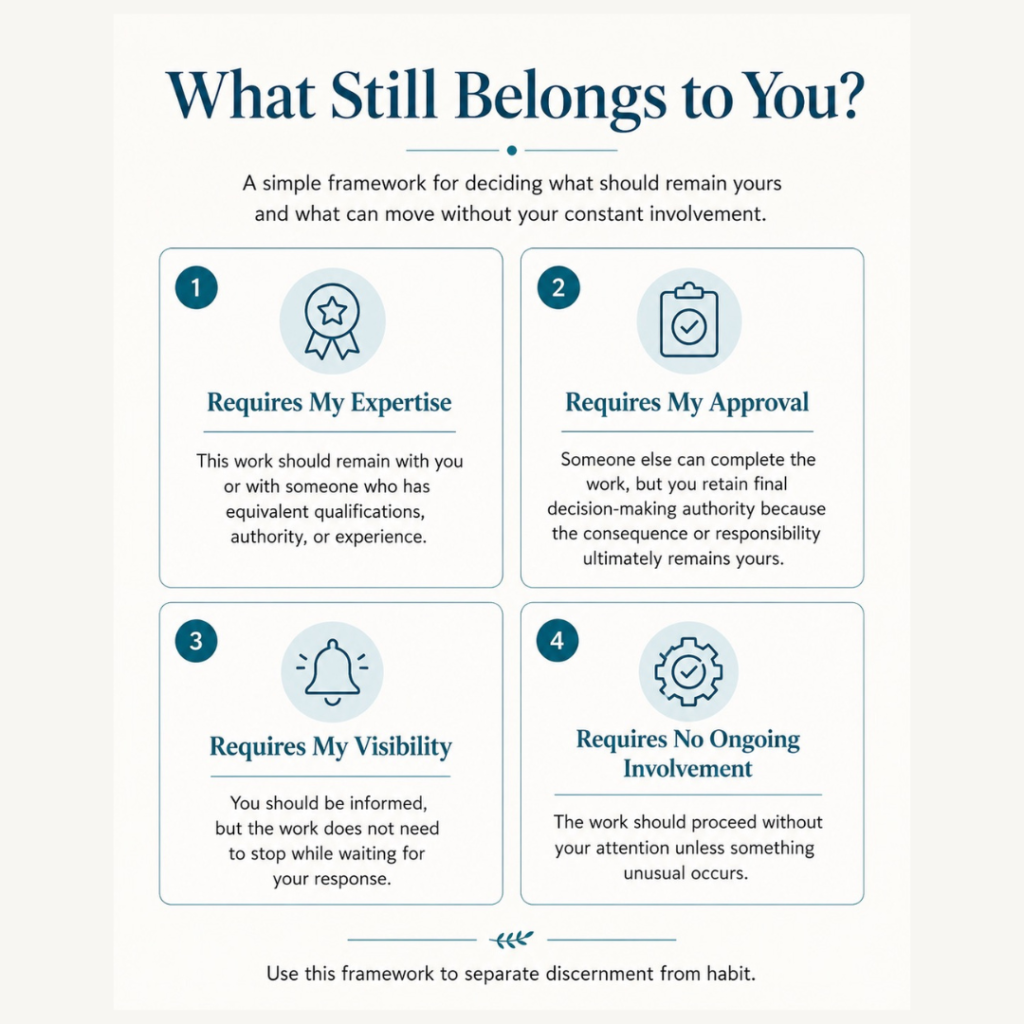
This distinction matters because many go-to people treat all four categories as though they are the first one. Everything appears to require their expertise because everything has historically passed through them.
But history is not always proof of necessity. Sometimes it is only proof of habit. Letting go is not passive. It is a decision construct. It asks what must remain yours, what only requires your awareness, and what should be permitted to move without you.
My 2 Cents
We often say we cannot let go because the standard matters. This is true. But sometimes we have quietly made ourselves part of the standard.
I’ve often told myself that no one else will care as much, notice as much, or perform the work with the same precision. Then we continue carrying responsibilities long after the structure should have changed. The result is not always excellence. Sometimes it is dependency dressed up as quality control.
Letting go does not mean becoming careless. It means deciding what must remain yours and building enough clarity, instruction, and accountability around everything else that it can move without your constant intervention.
The hardest part may not be trusting someone else to do the work. It may be trusting that you are still valuable when you are no longer the person required to carry all of it
Keep Thinking
You Wanted More Room This Summer. Your Systems Had Other Plans
A closer look at bottlenecks, compression, and what happens when too much still depends on you.
Systems Are How You Get Your Life Back
Why structure can create more room without requiring more effort.