
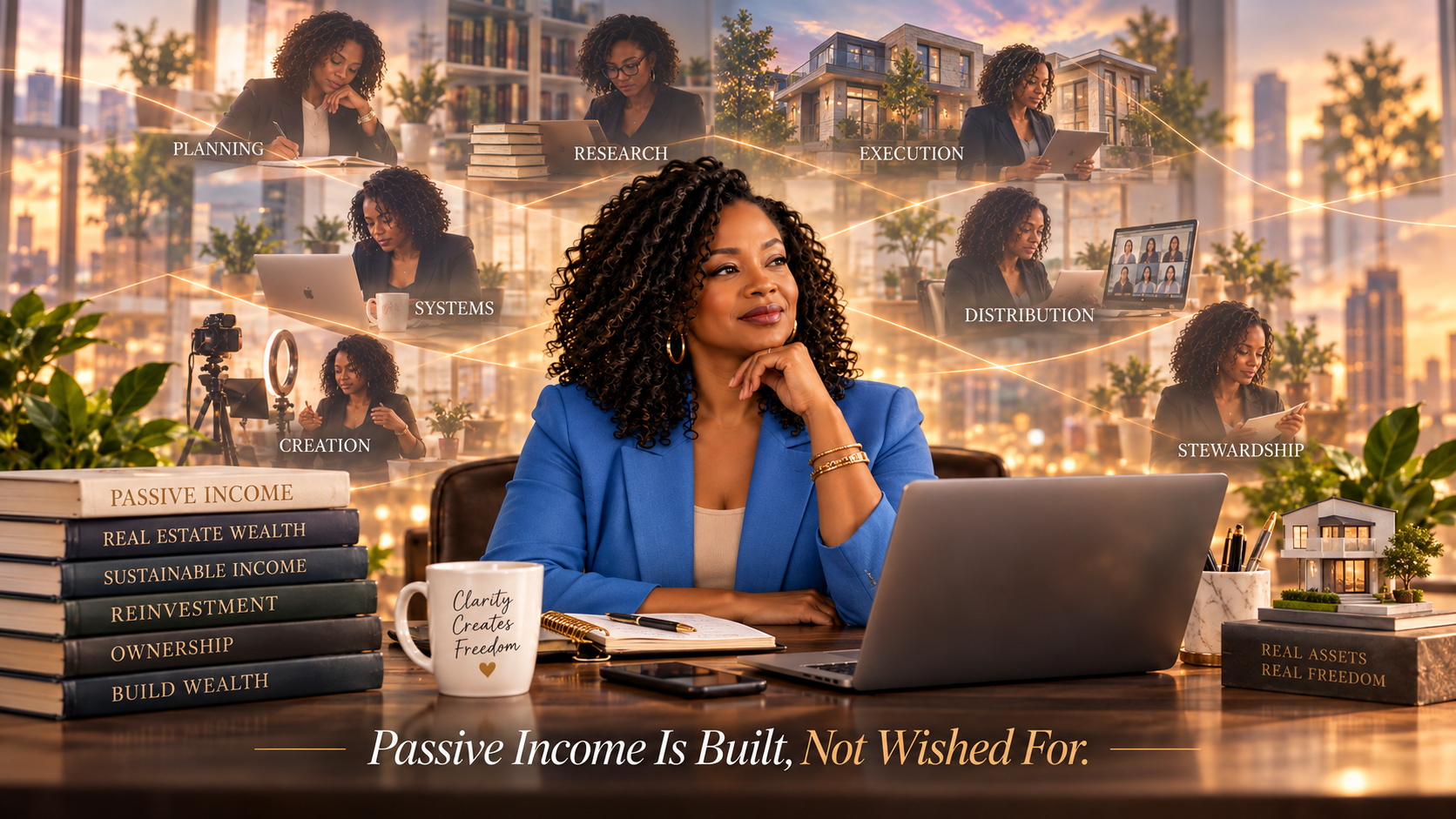
When people hear the phrase passive income, I think many of them hear one word louder than the other: passive. Passive sounds like doing nothing. It sounds like money arriving without interruption, without effort, and certainly without the kind of constant exchange of time for labor that most of us know very well. Somewhere along the way, passive income also picked up a kind of social status. It became associated with having figured something out, with freedom, wealth, even a certain level of sophistication. The implication is that if you have passive income, you have somehow escaped the ordinary rules of work.
I do not think that is what passive income is at all.
To me, passive income is less a thing than it is a structure. It is income attached to something that has been constructed in such a way that the same amount of labor is not required every single time value is delivered. That is very different from saying no work happened. In fact, the opposite is usually true. Most passive income is front-loaded. Something had to be imagined, built, tested, funded, organized, positioned, distributed, protected, maintained, or all of the above before it ever had the opportunity to become passive.
That is the part I think we skip.
The Structure Beneath the Income
Real estate is probably one of the clearest examples because it is one of the first places people tend to go when they think about passive income. The picture seems straightforward enough: buy a property, rent it, collect the income. From the outside, that can look relatively nonintrusive. The tenant pays rent, the owner receives the money, and the property keeps working.
Except anyone who has actually owned, managed, financed, inherited, repaired, sold, or even seriously evaluated real estate knows how much construction happens before that rent payment ever begins to feel passive. There is acquisition, financing, due diligence, insurance, maintenance, compliance, reserves, risk, tenant placement, management, and sometimes a whole lot of unexpected problem-solving. Some months the property behaves exactly as planned. Other months it reminds you that it has its own agenda.
What looks passive on the back end can require a significant amount of work on the front end.
And that is not unique to real estate. A book may eventually sell without the author standing beside every copy, but it still had to be written, edited, produced, distributed, and positioned first. A course may generate revenue without requiring the creator to teach it live every single time, but it still had to be conceived, organized, recorded, tested, and delivered. A digital product, template, licensing model, subscription, or recorded training may eventually produce income without the same amount of ongoing effort, but none of those things appear simply because someone wanted passive income badly enough.
Passive income is not the absence of labor. It is a different relationship to labor.
And I think that distinction matters because we have gotten accustomed to admiring outcomes while ignoring the structure underneath them. We see what continues to produce and assume that the absence of visible labor means there was no labor at all. But most things that create value over time were built very actively before they ever became capable of operating more passively.
Everything New Has to Be Constructed
Whenever we venture into something new, it has to be constructed. Period.
Even when we inherit something, that does not completely release us from the work of construction. We may inherit a property, a business, a name, a body of work, a financial asset, or some other form of legacy. That certainly gives us something to begin with, but receiving something and knowing how to carry it forward are not the same thing. If it is going to become ours in any meaningful way, we still have to show up. We may need to maintain it, protect it, reinterpret it, restructure it, modernize it, or decide whether it even belongs in the life we are trying to build.
Legacy can give us a head start. It does not eliminate stewardship.
I think that is important because the passive-income conversation is sometimes framed as though the goal is to arrive at the point where nothing is required of us. I am not convinced that point actually exists. The requirement may change. The intensity may change. The amount of direct labor may decrease. But ownership, stewardship, decision-making, and responsibility do not necessarily disappear.
That is also why I have been thinking differently about this whole idea of the modern “creator.” We use the word constantly now: content creator, digital creator, educator-creator, creator economy. Maybe this is just my opinion, but I often hear a newer word wrapped around something we have been doing for a very long time, which is entrepreneurship.
The tools are different. Distribution is different. Access is certainly different. The barrier between an idea and an audience has changed dramatically. But at the center of it, people are still doing what entrepreneurs have always done. They are identifying something they know, something they can make, something they can teach, something they can solve, or something they believe has value, and then figuring out how to construct something around it.
What has changed is that the “thing” does not have to be physical anymore.
It can be a digital product. A framework. A process. A methodology. A body of research. A membership. A recorded lesson. A licensing opportunity. A way of explaining something. A system that makes a complicated process easier to understand. We are dealing much more openly now with the idea that knowledge itself can be developed into an asset.
And that brings me back to intellectual property, because this is one of the places where the conversation becomes much larger than simply asking, How can I make money while I sleep?
The Asset May Start as a Dream
Before there is a product, there is often a thought. Before there is a framework, there is usually a pattern someone noticed. Before there is a course, there is something someone realized they could teach. Before there is a business, there is often a conception of what could exist.
Sometimes there is simply a dream.
I do not mean that in some vague, esoteric sense. I mean it quite literally. Many of the things we eventually build begin in a form that cannot yet be touched. A dream. An idea. A question. A frustration. A repeated observation. Something we keep returning to because we can see, at least partially, what it might become before anyone else can.
Dreaming and construction, however, are not the same thing.
The dream is the potential. The doing gives it form.
We develop it. We name it. We test it. We refine it. We decide what it is for and who it is for. We build the structure around it. We determine how it will be delivered. We protect it when protection is appropriate. We speak it into existence not simply by saying it, but by doing the things that allow the idea to become real.
That is the difference.
A dream may begin the process, but construction is what creates something capable of producing value.
And once that happens, the value does not have to be tied to something we can physically hold. That is one of the reasons I think people still underestimate what they already possess. We understand a house as an asset because we can see it. We understand inventory because we can count it. We understand equipment because it takes up space.
But what about the process you developed after years of doing something the hard way? What about the framework you use so often that you no longer recognize it as unusual? What about the way you teach something that people repeatedly tell you finally made it make sense? What about the material you have written, the research you have accumulated, the system you built because you got tired of answering the same question from scratch?
Those things may not be sitting on a shelf.
They can still be assets.
This is probably the part of the passive-income conversation that interests me most, because we are often encouraged to go find some new passive-income idea as though the answer must exist somewhere outside the work we are already doing.
You May Already Be Doing the Thing
I am not convinced the answer is somewhere outside the work we are already doing.
We may already be doing the thing that has the potential to become passive income. We simply have not looked at it that way.
What do people repeatedly ask you to explain? What have you learned how to do because necessity forced you to figure it out? What have you taught more than once? What process have you built because you were tired of recreating the same answer? What have you written, organized, developed, or refined that someone else could potentially use without requiring you to reproduce the entire experience every time?
And perhaps the more uncomfortable question: what do you know so well that you have stopped recognizing it as valuable?
I think we discount familiarity. When something becomes easy to us, we assume it must be obvious to everyone else. But familiarity does not diminish value. Sometimes familiarity is simply evidence that we have spent enough time with something to understand it deeply.
That does not mean everything should become a product. I do not believe every thought needs a price tag attached to it. I do not think every idea needs to be monetized, and I certainly do not think the goal of creative or intellectual work should always be to extract another stream of income from it.
But if we are talking about income without exhaustion, then I do think it is worth asking whether some of what we already know, create, teach, or solve could be constructed differently.
Earlier this month, I wrote about the idea that what we create should outlive the moment in which we created it. Some work continues because it teaches. Some because it preserves memory. Some because it gives people language. Some because it becomes the foundation for something else. The point was never that everything must become income.
But passive income is one possible extension of that same idea.
If something can continue to provide value after its first use, then under the right structure, some of that continuing value may also become economic.
That does not have to be the purpose of the idea.
It may simply be one of its possibilities.
And that brings me to what I think is a much better question than, How do I find passive income?
What have I already built, taught, solved, dreamed, explained, or created that could continue to provide value without requiring me to start over every single time?
That question feels far more useful to me.
My 2 Cents
I think passive income has been marketed as an outcome for so long that we sometimes forget to look underneath it. We want the rent check, the book sale, the course purchase, the licensing fee, the digital download, or whatever version of recurring income makes sense to us. What we do not always see is the period before that, when somebody was doing a lot of very active work.
That does not make the income less passive later. It simply makes the story more complete.
I also think many of us are closer to an asset than we realize. We may already be teaching the thing. Solving the thing. Writing about the thing. Explaining the thing. Building the thing informally because we needed it ourselves or because somebody else kept asking for it.
Maybe the question is not whether we need another idea.
Maybe the question is whether we have actually looked closely enough at what we are already doing and asked what it could become.
Passive income is not wished into existence. It is constructed.
And sometimes the raw material is already sitting right in front of us.
Keep Thinking
Why Everything You Create Should Outlive the Moment
An idea does not necessarily complete its useful life when its first use is over.
You Cannot Scale a Life You Built for Constant Effort
Scale begins when value can continue without requiring the same amount of effort from you every single time.